India’s e-rickshaw industry is growing at a pace that is hard to ignore. What was once largely driven by small assemblers and local manufacturers is gradually turning into a more organized manufacturing sector. New players are entering the market, existing manufacturers are increasing production, and buyers are expecting better quality, faster delivery, and more reliable vehicles.
But scaling production is not as simple as adding another assembly line.
An e-rickshaw manufacturer has to coordinate motors, controllers, batteries, tyres, seats, electrical components, chassis parts, and dozens of other items coming from different suppliers. At the same time, production teams need accurate material availability, purchase teams need supplier visibility, quality teams need traceability, and management needs to know whether the factory is actually operating as efficiently as it should.
For a business that is still small, spreadsheets and separate software may seem sufficient. But as orders increase, those systems start creating gaps. A purchase order may be ready while the required material is still unavailable. Inventory figures may not match the actual stock on the shop floor. A quality issue may take hours to trace back to a particular supplier or batch.
This is where a purpose-built ERP for e-rickshaw manufacturers becomes important.
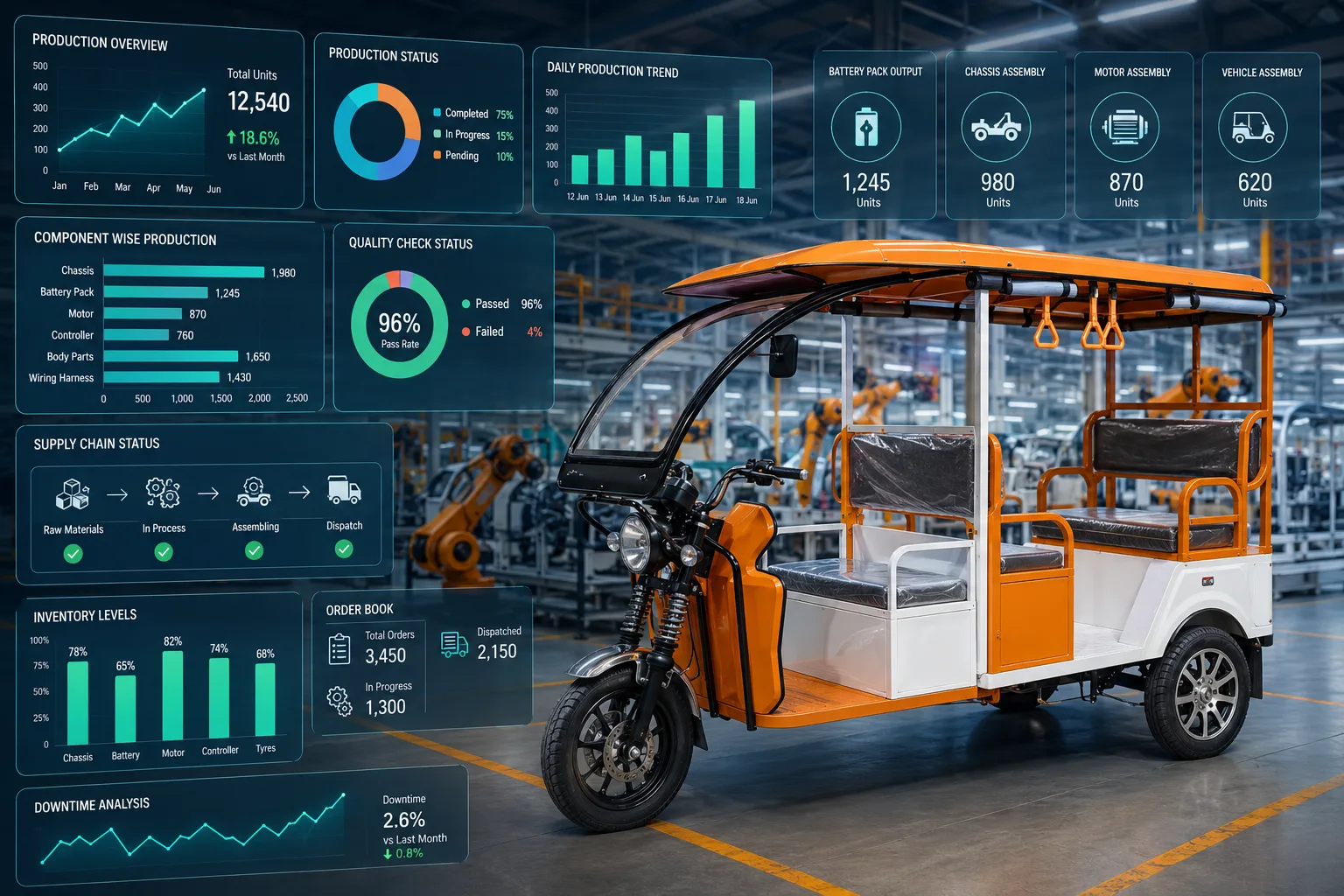
A modern ERP Software for Manufacturing Industry can bring procurement, inventory, production, quality, sales, and financial information together in one system. With AI added to that foundation, the ERP can also help manufacturers identify supplier risks, improve production planning, forecast demand, and respond to problems before they affect output.
For e-rickshaw manufacturers preparing for the next stage of growth, the question is no longer simply whether they need software. The bigger question is whether their existing systems are capable of supporting the scale and complexity they are moving toward.
In this article, we’ll look at the growth of India’s e-rickshaw market, the operational challenges manufacturers are facing, how AI-powered ERP can address those problems, and how Tanaashi is helping manufacturers create a stronger digital foundation for long-term growth.
1. E-Rickshaw Industry Growth & Increasing Operational Pressure
India’s e-rickshaw market is no longer a small niche within the automotive sector. It is developing into a significant part of the country’s electric mobility ecosystem.
The market was estimated at around USD 1.62 billion in 2026 and is projected to reach approximately USD 3.14 billion by 2031, representing a CAGR of 14.12% [1]. Uttar Pradesh accounted for 37.80% of national sales in 2025, while Punjab recorded a CAGR of 27.20%, making it one of the fastest-growing state markets [1]. Looking further ahead, the market is expected to grow from approximately USD 1.42 billion in 2025 to USD 4.73 billion by 2034 [2].
The wider electric three-wheeler segment is showing similar momentum. During FY2026, electric three-wheelers recorded 830,818 sales, representing 19% year-on-year growth and around 34% of India’s total EV market [3].
Passenger electric three-wheelers reached a penetration rate of 73.95% during H1 2026, while cargo electric three-wheelers reached 60.66% [4]. The continued adoption is particularly significant because the market is increasingly moving beyond being driven purely by incentives.
Cost is another major reason for the popularity of e-rickshaws. A typical e-rickshaw can cost around ₹0.6–1.1 lakh, compared with approximately ₹1.5–3 lakh for a comparable fuel-powered auto-rickshaw, while operating costs can also be considerably lower [5].
For manufacturers, this represents a substantial opportunity.
But growth also exposes weaknesses in the way a factory is managed.
A business producing a limited number of vehicles may be able to keep track of purchases, stock, production, and suppliers using spreadsheets and manual registers. Once production volumes increase, however, the number of transactions and dependencies increases with them.
More suppliers mean more purchase orders.
More vehicle models mean more bills of materials.
More production means more inventory movements.
More customers mean more pressure on delivery schedules.
More markets mean more documentation and compliance requirements.
This is why an ERP software for small manufacturers can be particularly useful during the transition from a small assembly operation to a structured manufacturing business. The objective is not simply to digitize paperwork. It is to create visibility across the operation before growth makes existing processes difficult to control.
The manufacturers that scale successfully are often not the ones with the biggest facilities. They are the ones that know what is happening across procurement, inventory, production, and quality — and can act before a small issue becomes a major disruption.
2. Challenges E-Rickshaw Manufacturers Face Today
The e-rickshaw industry has its own operational realities. Manufacturers are dealing with fragmented supply chains, price-sensitive markets, different battery technologies, inconsistent component quality, and increasing expectations around compliance and traceability.
These challenges become more difficult when information is spread across multiple systems.
Supply Chain Volatility
The e-rickshaw manufacturing ecosystem remains highly fragmented. India has more than 300 e-rickshaw manufacturers and assemblers, and many of them depend on CKD units or externally sourced components such as motors, controllers, tyres, seats, lights, and other parts [6].
The motor and controller are among the most important cost elements in the vehicle’s bill of materials. Strong competition on pricing can encourage manufacturers to source components primarily on cost, which can create quality and consistency issues [6].
There are also significant differences between organized and unorganized players. Unorganized manufacturers are estimated to move around 10,000 e-rickshaws every month, more than five times the volume of organized players [7].
For a manufacturer trying to grow beyond this fragmented environment, supplier visibility becomes essential.
A supplier delivering two days late may not seem like a major problem when viewed in isolation. But if that supplier provides a component that is required before final assembly, those two days can affect the entire production schedule.
The same applies to quality.
A low-cost component that fails inspection can result in rework, material wastage, delayed dispatches, and customer complaints.
An integrated ERP can help manufacturers maintain a complete supplier history covering orders, delivery performance, prices, rejection rates, and quality records.
Instead of looking at a supplier only when a problem occurs, management can evaluate supplier performance over time.
Component and Battery Traceability
Battery technology is another area where the industry is changing quickly.
Lead-acid batteries still account for a significant part of the market because they are affordable, widely available, and supported by an established recycling ecosystem. At the same time, lithium-ion batteries are gaining importance, particularly through leasing and other alternative ownership models [8][9].
New battery buyback initiatives are also connecting old lead-acid battery disposal with discounts on newer lithium-ion systems [10]. Meanwhile, battery-swapping standards are being developed for two- and three-wheelers [11].
For manufacturers dealing with multiple battery suppliers and technologies, simply recording the quantity purchased is no longer enough.
They may need to know:
- Which supplier supplied the battery?
- Which batch did it come from?
- Which vehicle received it?
- When was it installed?
- What quality inspection was performed?
- What warranty information is associated with it?
- Which vehicles could be affected if a particular batch develops a problem?
A connected ERP can create this chain of information from procurement to production.
That traceability becomes especially valuable when a manufacturer needs to investigate a quality complaint or identify vehicles associated with a particular component batch.
Compliance and Quality
As the e-rickshaw industry becomes more organized, quality and regulatory requirements are becoming increasingly important.
Organizations such as ARAI and ICAT play an important role in vehicle testing and approval, while battery safety requirements under AIS-156 apply to relevant electric vehicles [12][13].
Certification requirements can also influence access to incentives and other benefits. Under the PM E-Drive framework, eligible vehicles need to meet applicable certification requirements, while regulatory and documentation requirements can vary across markets [14].
For manufacturers selling in multiple states, keeping track of certificates, test reports, supplier documents, vehicle specifications, and compliance deadlines manually can become a considerable administrative burden.
A manufacturing ERP can centralize this information and provide reminders when important documents or certifications require attention.
The benefit is straightforward: quality and compliance teams spend less time searching for information and more time working on actual quality improvement.
Inventory Management
Inventory is another area where manufacturing growth can quickly create problems.
An e-rickshaw contains a large number of individual components. If even one critical item is unavailable, the vehicle may not be completed on schedule.
At the same time, keeping excessive quantities of expensive components such as batteries, motors, and controllers can lock up working capital.
This creates a balancing problem.
Manufacturers need enough stock to keep production running, but not so much that cash remains unnecessarily tied up in inventory.
A connected erp system for manufacturing can provide visibility into current stock, reserved material, pending purchase orders, production requirements, and reorder levels.
That gives procurement teams a much clearer picture of what needs to be purchased and when.
3. Why E-Rickshaw Manufacturing Needs Discrete Manufacturing ERP
E-rickshaw production is fundamentally an assembly-based process.
Individual components are brought together to create a finished vehicle. The manufacturer may have separate models or variants, each with its own bill of materials, component requirements, production sequence, and quality checks.
This makes ERP for discrete manufacturing highly relevant to the e-rickshaw industry.
Unlike process manufacturing, where materials may be transformed continuously, discrete manufacturing focuses on individual products and assemblies. Automotive and auto-component manufacturing are common examples.
For an e-rickshaw manufacturer, a discrete manufacturing ERP can help manage:
- Bills of Materials
- Production orders
- Work orders
- Material requirements
- Component availability
- Assembly operations
- Inventory movements
- Quality inspections
- Supplier information
- Finished vehicle records
Consider a manufacturer producing three different e-rickshaw models.
The first model may use a lead-acid battery.
The second may use a lithium-ion battery.
The third may have a different motor-controller combination.
If these product structures are managed through spreadsheets, there is a greater possibility of selecting the wrong component or using outdated information.
An integrated ERP can maintain separate BOMs and production requirements for each model.
This becomes even more important as manufacturers add new variants or customize vehicles for different markets.
The goal is not simply to record production after it happens. The system should help production teams understand what needs to be produced, which materials are required, what is available, and where a potential shortage may affect the schedule.
4. AI-Driven ERP Advantages for E-Rickshaw Manufacturers
Traditional ERP systems have primarily been used as systems of record.
They tell businesses what was purchased, what was produced, what was sold, and what inventory remains.
AI changes the role of the ERP.
Instead of simply reporting what has already happened, AI can analyze patterns in the data and help teams make better decisions.
Across manufacturing and supply chain operations, AI adoption is increasing rapidly. A recent State of Manufacturing & Supply Chain report found that 97% of manufacturing and supply chain executives had adopted some form of AI, while 95% considered AI necessary for competitiveness [15].
A separate 2026 industry survey found that predictive AI adoption among manufacturers increased to 48%, while interest in AI for supply chain planning reached 35% [16].
For e-rickshaw manufacturers, several AI applications stand out.
Component Traceability
AI-powered systems can connect components, batches, serial numbers, suppliers, and finished vehicles.
If a quality issue is discovered in a particular motor or controller batch, the manufacturer can identify the affected production records much faster.
This can reduce the time required for investigation and allow quality teams to respond more accurately.
Instead of searching through paper records or multiple spreadsheets, the information can be available through a connected digital trail.
Vendor Risk Prediction
Supplier problems are often discovered after they have already affected production.
AI can change that approach.
By analyzing delivery history, quality results, rejection rates, lead times, and pricing patterns, an intelligent ERP can identify suppliers showing signs of increasing risk.
For example, a supplier whose delivery performance has gradually deteriorated may be flagged before the next major production order is placed.
This allows procurement teams to take preventive action.
They can negotiate revised delivery schedules, increase safety stock, identify alternate suppliers, or adjust production plans.
This is one of the important differences between a conventional ERP and a more intelligent manufacturing platform.
Production Planning Optimization
Production planning requires balancing multiple variables at the same time.
There may be customer orders waiting, limited machine capacity, different labour availability, incomplete material supplies, and suppliers with different lead times.
AI can analyze these variables together and help production teams develop better schedules.
If demand suddenly increases in a state such as Uttar Pradesh or Punjab, the system can help management understand whether existing material and capacity are sufficient to meet the additional requirement.
Instead of relying entirely on manual calculations, planners can make decisions using current operational data.
Demand Forecasting
Demand forecasting is another area where AI can provide value.
Historical sales, seasonal trends, current orders, regional demand, and inventory information can be analyzed to estimate future requirements.
This is particularly useful for components that have long procurement lead times.
A manufacturer can potentially identify future requirements for batteries, motors, controllers, tyres, and other critical components before the shortage actually occurs.
Together, these capabilities turn ERP from a passive record-keeping platform into a system that can actively support operational decision-making.
5. How AI Reduces Cost and Improves Manufacturing Speed
The real value of AI-powered ERP becomes visible when it starts affecting day-to-day manufacturing performance.
Take inventory as an example.
Traditional demand forecasting can achieve only around 60–75% accuracy in many situations, which can encourage manufacturers to maintain large safety stocks. Such inventory can tie up 20–35% of working capital [19].
AI-based forecasting can help manufacturers make more informed inventory decisions, and some reported implementations have achieved substantial inventory reductions [19].
The same principle applies to production.
When production schedules are created using accurate material and capacity information, manufacturers can reduce unnecessary idle time.
When supplier risks are identified early, the business has more time to find alternatives or adjust purchasing plans.
When component traceability is automated, quality teams can investigate issues faster.
When inventory information is updated centrally, procurement teams do not have to depend on multiple spreadsheets to understand material requirements.
Cloud ERP is increasingly being described as a digital backbone for modern supply chains, connecting planning, manufacturing, procurement, and supplier networks through a common platform [20].
Recent manufacturing research also indicates that ERP investments are increasingly being linked to productivity improvements, with 45% of respondents in one 2026 survey reporting staff productivity improvements from ERP investments and 61% planning to increase enterprise software spending [16].
For an e-rickshaw manufacturer, the impact can be practical rather than theoretical.
Better planning means fewer production surprises.
Better inventory control means less capital sitting unnecessarily in the warehouse.
Better supplier visibility means fewer last-minute purchase decisions.
Better traceability means faster quality investigations.
And better reporting means management spends less time collecting information and more time acting on it.
That is ultimately what a good manufacturing ERP should accomplish.
6. Why Small E-Rickshaw Manufacturers Should Not Wait Too Long
There is a common perception that ERP is mainly for large factories with multiple plants and thousands of employees.
That is no longer the case.
For a growing e-rickshaw manufacturer, implementing an ERP software for small manufacturers can actually be useful before the operation becomes difficult to control.
When a company is small, processes are relatively easy to manage.
The owner may personally know which supplier provides which component.
The production manager may know the status of every order.
The purchase team may remember which materials are due next week.
But as the company grows, this knowledge gets distributed across more people.
The business becomes dependent on individuals rather than processes.
An ERP creates standardized processes and a shared information system.
The manufacturer can gradually move from:
Manual records → Structured processes → Connected data → Intelligent decision-making
This makes ERP less of a luxury and more of an infrastructure investment for businesses planning to grow.
7. Connecting Manufacturing and Financial Operations
Manufacturers often use separate tools for accounting and operational management.
For example, finance may use accounting software while production, inventory, and procurement are managed through spreadsheets or another application.
This can create another information gap.
Management may know the financial position of the company but not have the same level of visibility into production efficiency, material consumption, or supplier performance.
A properly integrated ERP system for manufacturing can bring operational and financial information closer together.
Where Tally integration is supported, an ERP can also help businesses connect their manufacturing processes with their existing accounting environment instead of maintaining completely disconnected records.
This can be particularly useful for small and medium-sized manufacturers that have already established their accounting workflows and want to strengthen their manufacturing operations without creating unnecessary disruption.
The result is a more complete view of the business — from purchase and inventory to production, sales, and financial reporting.
8. Tanaashi: Your AI-First Digital Backbone for E-Rickshaw Manufacturing
At Tanaashi, we’ve built our ERP and manufacturing solutions around a simple problem: manufacturers should not have to depend on disconnected systems to understand what is happening inside their business.
The platform combines DigiSec ERP with AI-Tanaashi to provide connected capabilities across procurement, inventory, production, quality, and operational decision-making.
For e-rickshaw manufacturers, this means bringing important information into one connected environment.
Instead of looking at procurement separately from production, or inventory separately from quality, management can get a broader picture of the entire manufacturing operation.
AI-Tanaashi is designed to support areas such as vendor risk prediction, component-level traceability, and production planning.
That can help manufacturers answer questions that matter on the factory floor:
Which supplier is becoming unreliable?
Which component may create a production shortage?
Which battery batch is connected to a particular vehicle?
Which production order is likely to be delayed?
Where is inventory higher than required?
Where can production planning be improved?
These are not simply reporting questions.
They are decisions that can directly affect production costs, delivery schedules, product quality, and customer satisfaction.
Tanaashi is based in Noida, close to Uttar Pradesh, which represents a significant share of India's e-rickshaw market [1]. This proximity to a major e-rickshaw manufacturing and sales ecosystem provides valuable context around the operational challenges faced by manufacturers.
For businesses moving from small-batch assembly toward organized manufacturing, the need for better systems becomes increasingly clear.
Whether a manufacturer is looking for an ERP software for small manufacturers, an ERP for discrete manufacturing, or a broader ERP Software for Manufacturing Industry, the objective remains the same: create a reliable digital foundation that can support growth.
Conclusion: Smarter ERP Will Shape the Next Stage of E-Rickshaw Manufacturing
India’s e-rickshaw market is still growing, but the way manufacturers compete is changing.
Price will continue to matter, but quality, consistency, delivery performance, supplier reliability, and operational efficiency will become increasingly important as the industry becomes more organized.
Manufacturers cannot manage this level of complexity indefinitely through spreadsheets, manual registers, and disconnected applications.
They need a connected erp system for manufacturing that gives teams access to the same information and helps management understand what is happening across the business.
AI takes that capability further.
It can help identify supplier risks, improve demand forecasting, support production planning, and make component traceability easier.
For small and growing manufacturers, starting with an ERP software for small manufacturers can provide the structure required to scale without allowing processes to become unnecessarily complicated.
For e-rickshaw businesses operating an assembly-based production model, an ERP for discrete manufacturing can provide the right framework for managing BOMs, production orders, inventory, components, and quality processes.
And for manufacturers looking for a broader digital transformation, a complete ERP Software for Manufacturing Industry can connect the different parts of the business under one system.
The e-rickshaw industry is moving toward a more organized and technology-driven future.
The manufacturers that prepare for that future early will have an advantage — not necessarily because they have the largest factories, but because they have better control over the information that runs those factories.
At Tanaashi, the goal is to provide that digital backbone.
Because when a manufacturer can see what is happening across suppliers, inventory, production, quality, and orders — and can act before small problems become expensive ones — scaling becomes much easier.
The next phase of India's e-rickshaw industry will not only be about producing more vehicles.
It will be about producing them smarter, faster, and with greater control.